

What are the differences between fuel vehicles, EV, extended-range electric vehicles, plug-in electric vehicles, and hybrid electric vehicles?
1. Pure electric vehicles:
Completely rely on batteries for driving, advantages include powerful power output, fast acceleration, simple structure and low operating costs. Disadvantages mainly include range anxiety, difficulty in replenishing energy, unsuitable for long-distance travel and low value retention rate. This type of vehicle is suitable for users who already have fuel vehicles and can install charging piles, as well as users who mainly travel short distances in cities.
2. Plug-in hybrid vehicles:
Driven by batteries and engines, advantages include no range anxiety, can be charged and refueled, and suitable for short and long-distance travel. Disadvantages include complex mechanical structure, high maintenance and repair costs and relatively high failure rate. This type of vehicle is suitable for users who often use vehicles intensively and have complex and diverse vehicle use scenarios.
3. Extended-range electric vehicles:
The battery is charged by a gasoline generator and then driven by the battery. Advantages include ultra-long driving distance and refueling. Disadvantages include high fuel consumption when driving at high speeds, and long-term high-speed driving will cause excessive power consumption and reduced power. This type of vehicle is suitable for users who want to buy new energy vehicles but are inconvenient to charge, have range anxiety, and have long-distance needs.
4. Hybrid vehicles:
Batteries and engines can be connected in series or in parallel. Batteries are charged by generators. Advantages include more fuel efficiency than fuel vehicles, while retaining the advantages of fuel vehicles. Disadvantages include higher prices than fuel vehicles. Although they are hybrid vehicles, they cannot enjoy the green license policy. This type of vehicle is suitable for users who like fuel vehicles but pursue fuel efficiency, and those who drive more at low speeds.
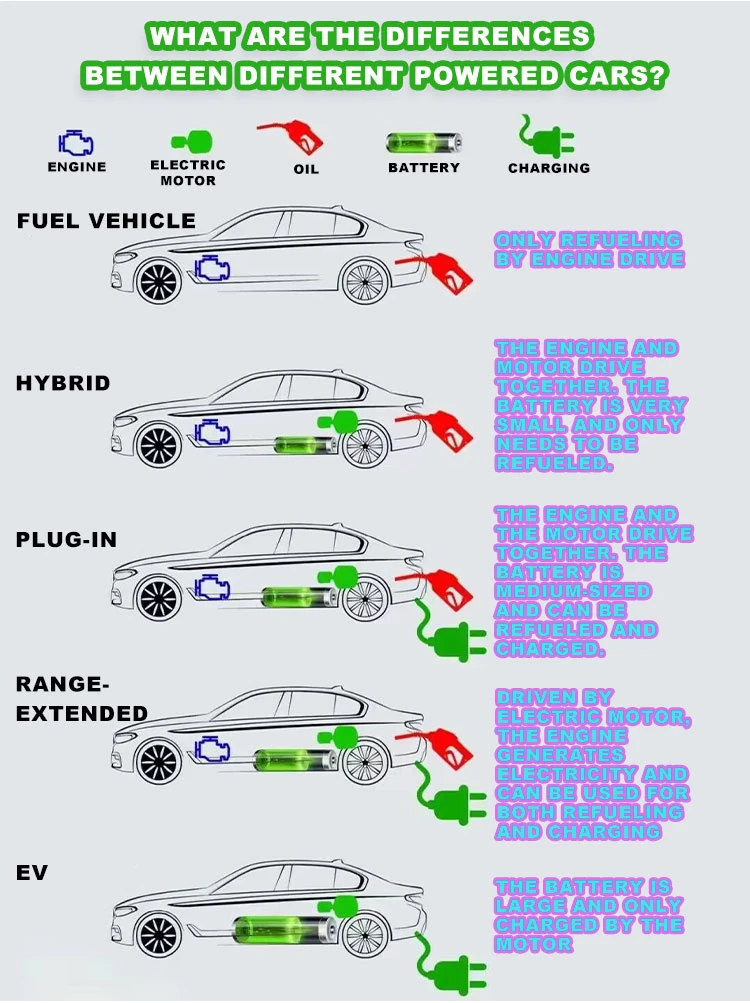
--Pure electric type-- completely driven by batteries
Advantages: strong power, fast acceleration, simple structure, low cost of use
Disadvantages: range anxiety, troublesome recharging, not suitable for long-distance travel, low value retention rate
Suitable for: those who already have oil cars, can install charging piles, rarely travel long distances, suitable for short-distance travel such as commuting in cities.
Representative models: Model 3, Model Y, AION Y, Han EV, Buick E5, BMW IX3.
--Plug-in type--driven by the cooperation of battery and engine
Advantages: no range anxiety, can be charged and refueled, can be used for short and long distances, can be equipped with new energy license plates.
Disadvantages: complex mechanical structure, high maintenance and repair costs, and relatively high failure rate.
Suitable for people: suitable for people who often use the car intensively, and people who use the car in complex and diverse scenarios.
Representative models: Qin PLUS DM-i, Tang DM, Weilan 6, Galaxy L7, Tengshi D9 DM-i, WEY Blue Mountain DHT-PHEV.
--Oil-hybrid type--battery and engine are connected in parallel or in series for hybrid drive, and the battery is powered by the engine
Advantages: More fuel-efficient than fuel vehicles, and other advantages of fuel vehicles are basically retained.
Disadvantages: More expensive than fuel vehicles, although it is a hybrid, it cannot be licensed as a new energy vehicle.
Suitable for: People who like fuel vehicles and pursue fuel efficiency, suitable for people who drive on low-speed roads.
Representative models: Camry, Accord, Xingyue L, Corolla, Lelink, Asia Dragon, Civic, Haval H6.
--Extended range type--The gasoline generator charges the battery, and the battery is finally driven through the series mode.
Advantages: Ultra-long battery life, refueling is possible, and new energy license plates can be obtained in most areas.
Disadvantages: High fuel consumption when driving on highways, long-term high-speed driving will consume electricity too quickly and reduce power.
Suitable for people: People who want to buy new energy but charging is inconvenient, have battery life anxiety, and have long-distance needs.
Representative models: Ideal one/L7/8/9, NETA S, Deepal L7, LEAPMOTOR C11, AITO M5/7, VOYAH FREE