


Sales figures are the easiest thing in this trade to state and the hardest thing to explain. A number on a slide says nothing about how a car gets from a yard in Guangzhou to a customer in Kigali, who checks it, who pays the port, and what happens when a document is wrong. So this piece reads our own numbers the operational way: what has to be true, week after week, for the volume to arrive.
The arc, read carefully
Car sales ran at 580 units in 2023, 1,660 in 2024 and 3,750 in 2025. By June 2026 the cumulative figure stood at 2,982. Three things matter about that curve. First, the growth between 2023 and 2024 was near tripling, which means the constraint was never demand. Second, the 2025 figure is the first one produced by a structure rather than by individual deals. Third, the half-year number for 2026 is not a decline in run-rate; it is a six-month cumulative, and it already approaches the whole of 2024.
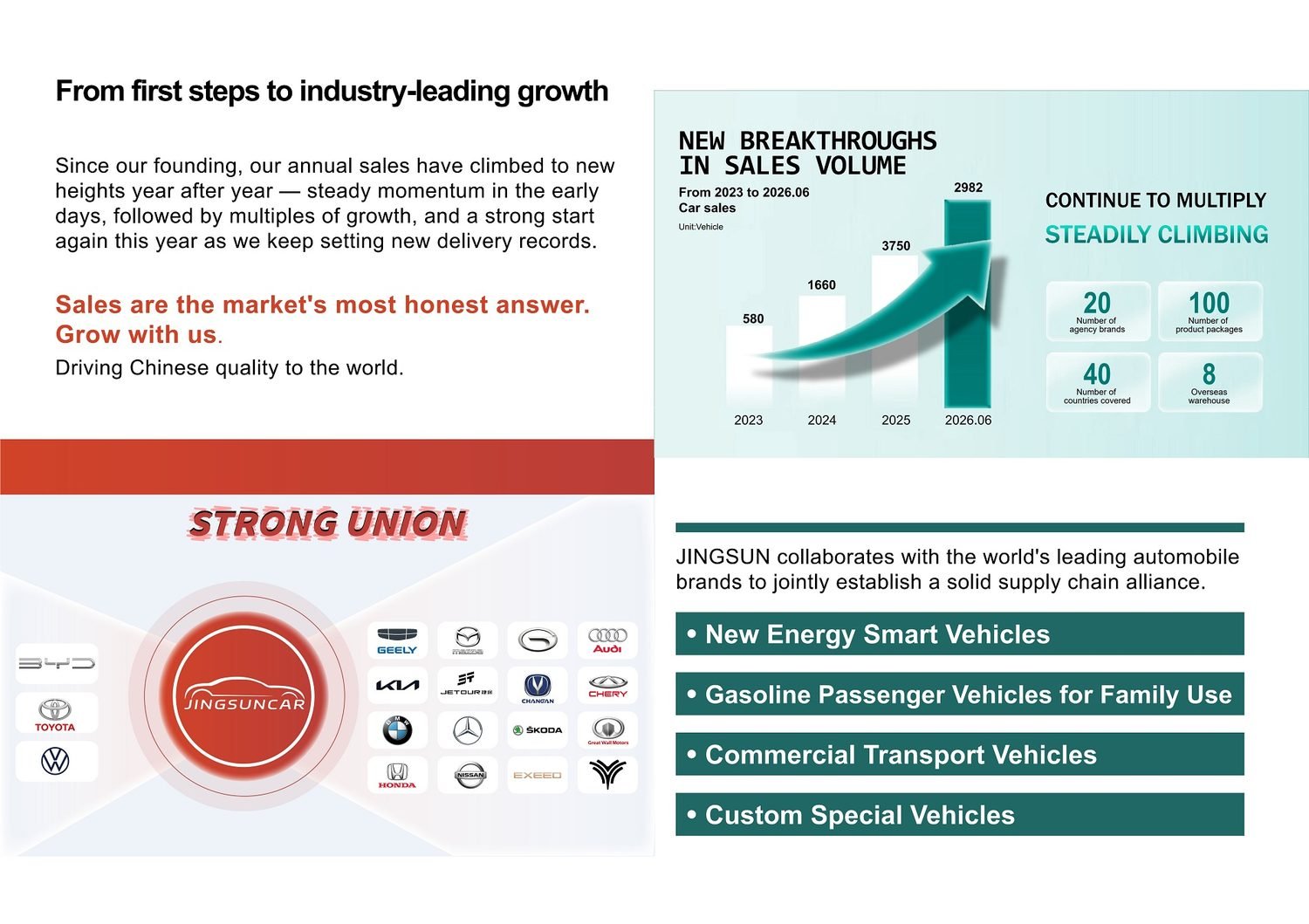
What a curve like that costs internally is unglamorous: more people checking cars, more paperwork per container, more places where a mistake can strand a shipment. Growth in vehicle export is not won in the sales conversation. It is won in the inspection bay and the document folder.
What four bases actually do
We operate from Guangzhou and from bases in Cambodia, Rwanda and Algeria. Read plainly, that is a sourcing engine in China and three local market positions in the regions we sell into. The practical difference appears when something goes wrong at the destination end: a registration question, a parts request, a buyer who needs to see stock rather than a listing. A local presence converts those from an email chain into a conversation.
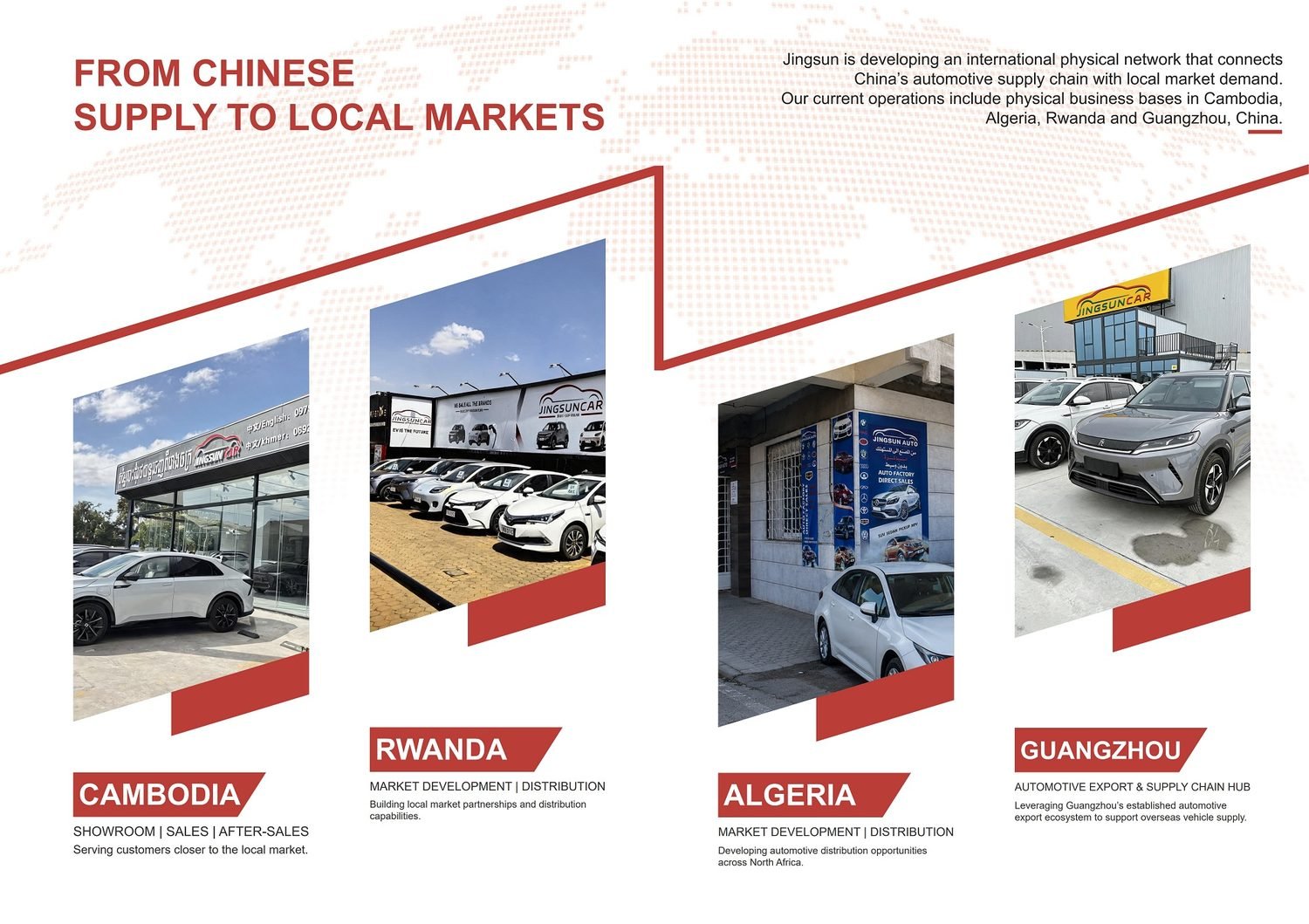
Breadth: 20 brands, 100 packages, 40 countries
We work with 20 agency brands, carry 100 product packages and have delivered into 40 countries. The breadth is not decoration. A buyer in one market wants a cheap petrol sedan for family use; another wants a new-energy hatchback for city fleets; a third wants a commercial chassis. Carrying one brand well would make us easier to describe and much harder to buy from.
Ten years in the trade is the other half of that sentence. It is the difference between knowing a model's common failure points and reading them off a spec sheet.
Eight warehouses: stock position beats speed
Eight overseas warehouses change the shape of an offer. Stock held near the buyer means a unit can be seen, sat in and inspected before money moves, and it means small orders do not have to wait for a full container to make commercial sense. The cost of that position is capital tied up in metal sitting still, which is why not every exporter runs it.
The six functions that make a shipment arrive
Underneath the numbers sits a fixed sequence: sourcing, quality control, warehousing, international logistics, export documentation and overseas support. Each one can fail independently, and any failure shows up at the same place, which is the port, at the worst possible moment.
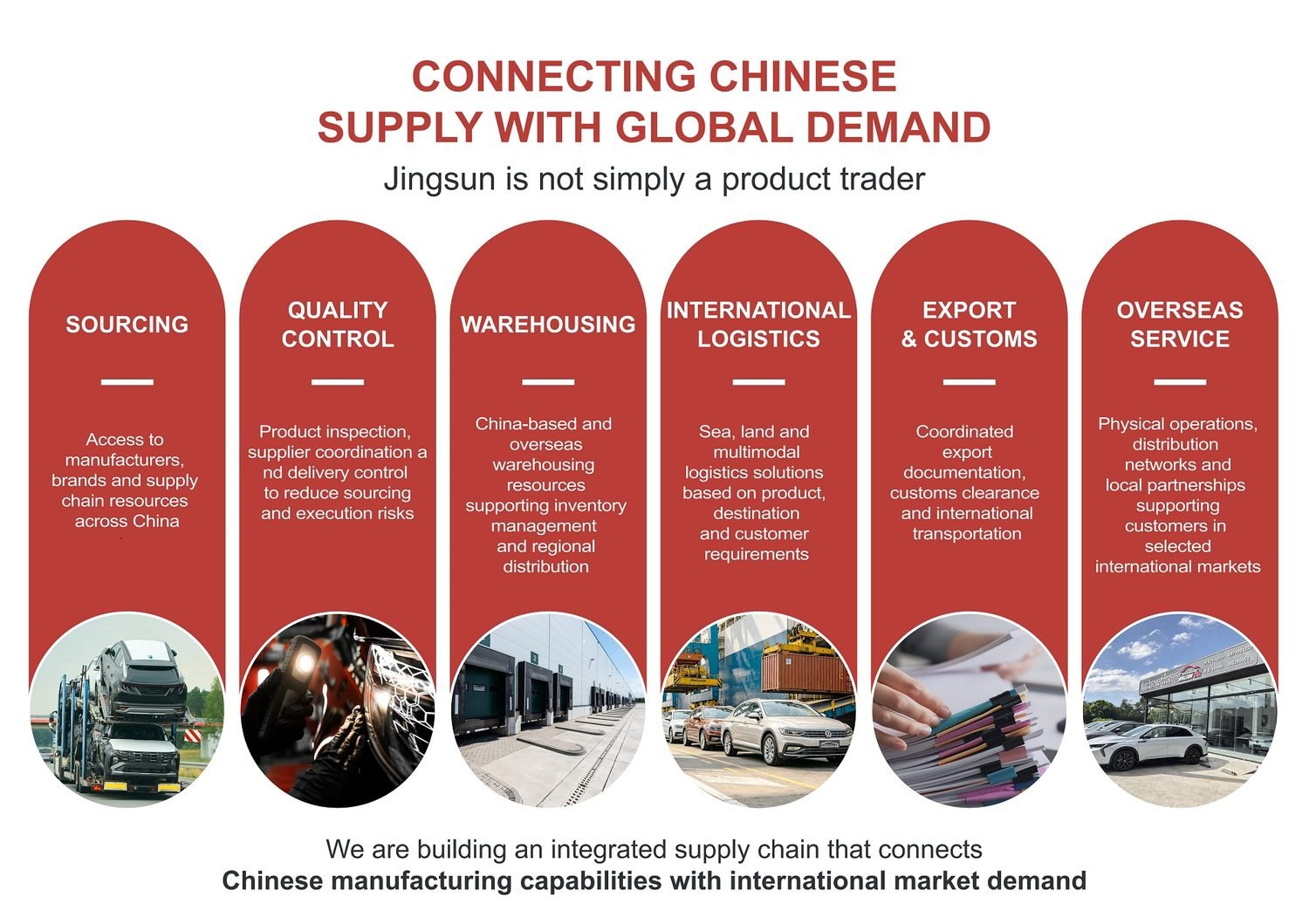
Quality control is the one buyers underestimate. It is not a final wash and a photograph; it is the inspection file we described in our guide to verifying a car before it ships. Documentation is the other quiet failure point: an invoice whose model description does not match the registration will stop a container more reliably than any customs officer.
Beyond CBU: CKD, SKD, DKD and parts
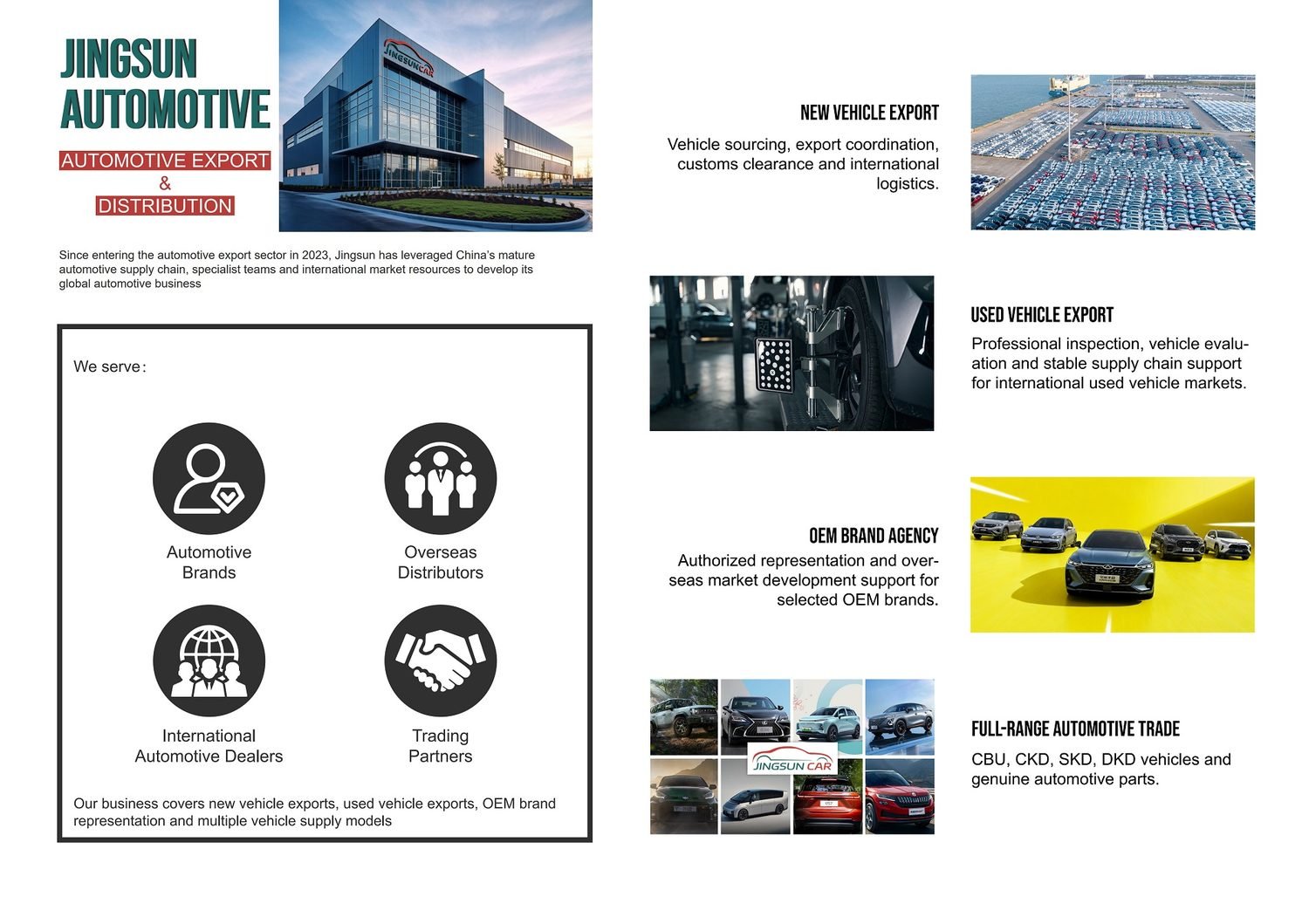
Not every market wants whole vehicles. We supply CBU, CKD, SKD and DKD, plus genuine parts. The knock-down routes exist for markets where complete vehicles attract a different duty treatment or where local assembly is a condition of entry. They also raise the difficulty: more documentation, more packing discipline, and a buyer who has to be able to assemble. We would rather say that plainly than sell a kit to someone who wanted a car.
What a buyer should take from this
Three things. Ask for the inspection file, because volume operations have a process and should be able to produce it. Ask where the stock physically sits, because a listing is not a location. And ask which of the six functions is handled in-house, because that answer tells you who owns the problem when something breaks.
Summary
3,750 vehicles in a year is a claim about capacity, paperwork and people, not about ambition. The numbers are on the deck; the work is in the bay, the warehouse and the document folder. That is the part worth checking before you place an order.
Company Name: Jingsun Car Co., Ltd
Website: https://www.sin-auto.com/?url=jingsuncar.com
Service Countries: Ghana / Algeria / Cambodia / Middle East / East Africa (Years of practical experience, familiar with customs clearance rules of various countries)